



Buying a home is exciting, but the process can involve many unfamiliar terms. From preapproval to closing costs, mortgage terminology can make an already big decision feel more complicated than it has to be.
Learning the most common mortgage loan terms can make conversations with your lender easier, prepare you for the homebuying process, and give you a clearer sense of what you’re reviewing before you sign. Use this mortgage loan glossary as a starting point, then lean on Call Federal Credit Union’s mortgage team when questions come up along the way.
Blog Summary
This guide explains common mortgage terms homebuyers may hear before and during the mortgage process. You’ll learn what terms like preapproval, APR, debt-to-income ratio, PMI, escrow, appraisal, title, and closing costs mean, plus how Call Federal’s mortgage checklist can keep important tasks organized from application to closing.
Mortgage Loan Terms Covered in This Guide
The Mortgage Process
Before diving into individual mortgage loan terms, it’s useful to know the major stages of the mortgage process. The exact path can vary, but most home loans move through a version of the following steps.
Prequalification
Prequalification is an early estimate of how much you may be able to borrow based on basic information you provide. It can be a good starting point when you are still setting a budget or beginning your home search.
Because prequalification is usually less detailed than preapproval, it should be viewed as an estimate rather than a final loan decision.
Preapproval
Preapproval is a more detailed review of your income, credit, debt, and other financial details. A lender may ask for documentation and run a credit check before issuing a preapproval amount.
A preapproval letter can be useful when you are ready to make an offer because it shows sellers that a lender has reviewed your information. It can also give you a more realistic price range as you shop for a home.
Application
The mortgage application is the formal request for a home loan. During this stage, you provide personal and financial information, along with documents such as pay stubs, tax forms, bank statements, identification, and property details.
The application gives the lender the information needed to begin a full review of the loan request.
Loan Processing
Loan processing is the stage when the lender organizes and checks the documents connected to the application. The loan processor may verify information, request missing items, and prepare the file for underwriting.
This stage is one reason staying organized matters. Having documents ready can make the process smoother.
Underwriting
Underwriting is the lender’s detailed review of the loan file. The underwriter evaluates credit, income, assets, debt, the property, and other factors to determine whether the loan meets program and lender guidelines.
The underwriter may approve the loan, ask for additional information, or issue conditions that must be addressed before closing.
Closing
Closing is the final step in the mortgage process. This is when the buyer, seller, lender, and other parties complete the transaction by signing legal and financial documents.
At closing, you may pay closing costs and any remaining funds required for the purchase. Once the documents are signed and the transaction is complete, ownership transfers to the buyer.
Credit
Credit is one of the major factors lenders review when evaluating a mortgage application. Your credit history shows how you have managed borrowed money in the past, including credit cards, auto loans, student loans, and other accounts.
Credit can affect approval, pricing, loan program eligibility, and the amount a lender may be willing to finance. Before applying for a mortgage, it can be helpful to review your credit report, continue making payments on time, and avoid taking on new debt.
Debt-to-Income Ratio
Debt-to-income ratio, sometimes called DTI, compares monthly debt payments to gross monthly income. Lenders use this number to evaluate how much room exists in your budget for a mortgage payment.
Monthly debts may include credit cards, auto loans, student loans, personal loans, and other recurring obligations. A lower debt-to-income ratio can make it easier to qualify for a mortgage because it suggests that less of your income is already committed to debt payments.
Down Payment
A down payment is the amount you pay upfront toward the purchase price of a home. The rest of the purchase price is financed through the mortgage.
Down payment requirements can vary by loan program, property type, and borrower qualifications. Some buyers choose to make a larger down payment to lower the amount borrowed, change the monthly payment, or reduce certain costs. Others may qualify for programs with lower upfront cash requirements.
Some government-backed loans, grant programs, and down payment assistance programs may also be available to eligible buyers. Ask a mortgage loan officer what may apply to your purchase.
Interest Rate vs. APR
Interest rate and annual percentage rate, or APR, are related, but they do not mean the same thing.
The interest rate is the cost of borrowing the loan amount, expressed as a percentage. It affects the principal and interest portion of the monthly mortgage payment.
APR gives a broader view of borrowing costs because it includes the interest rate plus certain fees and costs tied to the loan. That means APR can be useful when comparing loans because it gives a wider picture of the total cost.
When reviewing loan estimates, look at both the interest rate and APR. A loan with a lower interest rate may not always have the lowest total cost once fees are included.
Fixed-Rate vs. Adjustable-Rate Mortgage
A fixed-rate mortgage has an interest rate that stays the same for the life of the loan. This creates a predictable principal and interest payment, which can be appealing for buyers who plan to stay in the home for many years.
An adjustable-rate mortgage, or ARM, starts with a rate that stays fixed for an initial period. After that period ends, the rate can change based on the terms of the loan. ARMs may start with a lower rate than a comparable fixed-rate loan, but future payment changes are possible.
When comparing a fixed-rate mortgage and an ARM, review how long you plan to keep the home, how much payment stability matters, and what the payment could look like if the rate adjusts. Buyers who are still comparing types of mortgage loans may want to review how conventional, ARM, FHA, VA, and USDA loans differ before applying.
Loan Term
A loan term is the length of time you have to repay the mortgage. Common mortgage terms include 30-year, 20-year, 15-year, and 10-year loans, though available terms can vary by lender and loan program.
A longer term may create a lower monthly payment because the repayment is spread across more years. A shorter term may come with a higher monthly payment, but it may lower the total interest paid across the life of the loan.
The loan term you choose can affect monthly payment, interest costs, and how quickly you build equity.
PITI
PITI stands for principal, interest, taxes, and insurance. Together, these four pieces make up a large portion of the monthly mortgage payment.
Principal is the amount borrowed. Interest is the cost of borrowing that money. Taxes refer to property taxes. Insurance may include homeowners’ insurance and, in some cases, mortgage insurance.
When planning a housing budget, it is important to look beyond principal and interest alone. Taxes and insurance can make the total monthly payment higher than the loan payment shown in a simple estimate.
Private Mortgage Insurance
Private mortgage insurance, or PMI, is insurance that protects the lender if a borrower defaults on a conventional mortgage. PMI is not the same as homeowners’ insurance, which protects the property and belongs to the homeowner.
PMI is commonly tied to conventional loans with smaller down payments. It may be included in the monthly mortgage payment and can affect the total cost of the loan.
If PMI applies, ask when it may be removed and what equity or payment history requirements must be met.
Appraisal
An appraisal is a professional opinion of a home’s value. Lenders use appraisals to confirm that the property value supports the loan amount.
During an appraisal, a licensed appraiser reviews the property and compares it to similar recently sold homes in the area. The appraiser may consider size, condition, location, features, and market activity.
An appraisal is different from a home inspection. The appraisal is primarily for the lender’s valuation review, while an inspection focuses more closely on the condition of the home for the buyer.
Title
The title refers to the legal ownership of a property. When you buy a home, the title transfers from the seller to the buyer.
Before closing, a title company may perform a title search to look for issues such as liens, ownership disputes, or recording errors. Title insurance can protect the buyer and lender if certain title problems appear after closing.
Title-related fees may be part of closing costs.
Escrow
Escrow can mean different things depending on where you are in the homebuying process.
Before closing, escrow may refer to a neutral account where funds are held during the transaction. For example, earnest money may be placed in escrow after a buyer’s offer is accepted.
After closing, escrow may refer to the account used by the lender or loan servicer to collect and pay property taxes and homeowners’ insurance. In that case, a portion of the monthly mortgage payment goes into the escrow account, and those bills are paid when due.
Not every loan is structured the same way, so ask how escrow will work for your mortgage.
Fees and Penalties
Mortgage documents may include several fees connected to the purchase, loan, property, title, taxes, or closing. These can vary by lender, property, loan type, and location.
Examples may include origination charges, appraisal fees, credit report fees, title fees, recording fees, prepaid interest, and escrow deposits. Some loans may also include program-specific fees or mortgage insurance costs.
Penalty language is also worth reviewing. For example, buyers may want to ask whether a loan has any prepayment penalty. Call Federal does not charge prepayment penalties on mortgage loans, which gives borrowers more freedom to pay ahead when they choose.
Closing Costs
Closing costs are the expenses due at closing in addition to the down payment. These costs are tied to finalizing the purchase and mortgage.
Closing costs may include lender fees, title costs, prepaid taxes, homeowners’ insurance, appraisal fees, government recording fees, and escrow deposits. Because costs can vary, your Loan Estimate and Closing Disclosure are important documents to review carefully.
Ask your mortgage loan officer which costs are due upfront, which may be included in the loan, and which items could change before closing.
How to Use Call Federal’s Mortgage Checklist
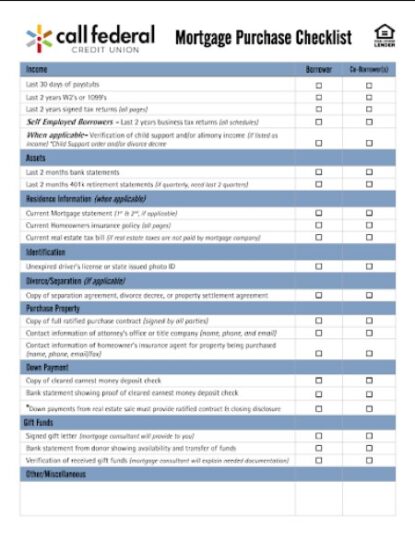
Mortgage terms are easier to manage when you have a clear process to follow. Call Federal’s mortgage checklist gives homebuyers a practical way to stay organized from the early planning stage through closing.
The checklist can be used to track important tasks, gather documents, and keep the home loan process from feeling scattered. It can also make conversations with your mortgage loan officer more productive because you will have a clearer sense of what has already been completed and what still needs attention.
What the Mortgage Checklist Can Help You Track
Use the checklist to keep track of items such as:
- Reviewing your credit
- Setting a homebuying budget
- Gathering income documents
- Saving for upfront costs
- Comparing loan programs
- Getting preapproved
- Making an offer
- Reviewing your Loan Estimate
- Scheduling inspections
- Preparing for closing
Feel More Prepared Before You Buy
Learning common mortgage terms can make the homebuying process feel more approachable. Once you know the language, it is easier to read loan documents, ask stronger questions, and compare mortgage options with less confusion.
Call Federal Credit Union is here to guide you from the first conversation through closing. Our mortgage team can explain the terms you are seeing, walk through your home loan choices, and answer questions before you apply.