



Starting a housing search can feel exciting, but it can also get overwhelming fast. One listing has the porch you love. Another is closer to work. Another stretches the budget, but the kitchen looks perfect. Before long, it can be hard to tell which homes are truly worth your time.
A home buying mission statement gives your search more direction. It puts your must-haves, nice-to-haves, budget range, and mortgage planning details into one short statement you can refer back to as you compare homes.
If you are wondering how to find a house to buy without getting pulled in too many directions, this exercise can give you a clear place to start.
Blog Summary
A home buying mission statement is a short paragraph that defines what you are looking for in a home, what features matter most, and what monthly mortgage payment feels realistic. It can be used to guide your housing search, keep conversations with real estate professionals focused, and prepare you for early mortgage discussions.
In this guide, we’ll cover how to separate wants from must-haves, how to determine your homebuying budget, what to think about during a Richmond, VA home search, how online platforms and realtors can work together, and how Call Federal Credit Union’s mortgage team can answer questions before you apply.
Table of Contents
- What Is a Home Buying Mission Statement?
- Home Buying Mission Statement Example
- Start With Your Must-Haves and Nice-to-Haves
- Think About Your Richmond, VA Housing Search
- How Do I Determine My Homebuying Budget?
- Review Your Employment, Savings, and Credit
- How to Start Your Housing Search
- Online Home Search Tools vs. Working With a Realtor
- How a Mortgage Loan Officer Can Be Part of the Process
- How to Use Call Federal’s Mortgage Checklist During Your Housing Search
- Start Your Home Search With a Clearer Plan
What Is a Home Buying Mission Statement?
A home buying mission statement is a short planning statement that explains what kind of home you are looking for, which features matter most, and what budget range you want to stay within.
Think of it as a filter for your housing search. Instead of reacting to every listing, you can use your mission statement to decide which homes deserve more attention.
A strong home buying mission statement may include:
- The type of home you want
- Your must-have features
- Your nice-to-have features
- Preferred areas or neighborhoods
- Your expected price range
- Your down payment plan
- A monthly mortgage payment range
- Notes about lifestyle, commute, school district, space, or future plans
This does not have to be perfect right away. Your first version can change as you learn more about home prices, mortgage programs, and what is available in the market.
Home Buying Mission Statement Example
Here is a simple example you can customize:
“The home I am looking to buy must have the following characteristics: [number of bedrooms, location, outdoor space, parking, home style, commute time, etc.]. It would be nice if it also had [large covered porch, updated kitchen, neighborhood pool, finished basement, paved driveway, etc.], but these features are not essential. Based on my income, savings, credit, and estimated upfront costs, I am planning for a purchase price around [home price range], a down payment of [amount or percentage], and a monthly mortgage payment around [monthly budget].”
Once you fill in the blanks, you’ll have a short statement you can share with your realtor, lender, spouse or partner, family member, or anyone else involved in the process.
Start With Your Must-Haves and Nice-to-Haves
This is the fun part. Before you think too much about mortgage numbers, start by writing down what you want in a home.
Maybe you picture a quiet neighborhood with mature trees. Maybe you want to be near restaurants, parks, or local shops. Maybe you need extra bedrooms, a fenced yard, a short commute, or space to work from home.
Start with two lists.
Must-haves are the features that would strongly affect your decision. These may include:
- Number of bedrooms or bathrooms
- Maximum commute time
- School district
- Yard size
- Parking
- Accessibility features
- Location near family, work, or childcare
- Home condition
- Monthly payment range
Nice-to-haves are features you would enjoy but could live without. These may include:
- A front porch
- Updated countertops
- A finished basement
- A garage
- A large kitchen
- A specific home style
- A neighborhood pool
- Extra storage
Separating these lists can keep your housing search grounded. A home may not have every dream feature, but it may still be a strong match if it checks the boxes that matter most.
Think About Your Richmond, VA Housing Search
If you are searching in the Richmond, VA area, location can shape both lifestyle and price. A home near downtown Richmond may offer a different pace than one in Chesterfield, Henrico, Midlothian, Mechanicsville, Short Pump, Glen Allen, or other surrounding communities.
As you build your home buying mission statement, think about how location affects daily life. A few questions to consider:
- How far do you want to be from work?
- Do you want quick access to I-95, I-64, Route 288, or Powhite Parkway?
- Do you prefer a walkable area or more space between homes?
- Are you looking for established neighborhoods or newer construction?
- How important are parks, schools, restaurants, or shopping nearby?
- Do you want to stay close to family, friends, or childcare?
Local context matters. The same budget can look different across the Richmond region, so it is worth comparing not only home prices, but also commute time, property taxes, insurance, utilities, and the type of lifestyle each area offers.
How Do I Determine My Homebuying Budget?
Your homebuying budget is more than the purchase price. It should include what you can comfortably pay each month, what you can contribute upfront, and what costs may come with buying and maintaining the home.
A mortgage calculator can give you a starting estimate, but it should not be the only step. A mortgage loan officer can review the details more closely and explain what may affect the numbers. Before that conversation, reviewing common mortgage loan terms can make estimates, costs, and loan details easier to follow.
When estimating your budget, think about:
- Monthly mortgage payment
- Down payment
- Closing costs
- Property taxes
- Homeowners insurance
- Possible mortgage insurance
- HOA dues, if applicable
- Utilities
- Moving expenses
- Repairs or updates after purchase
- Emergency savings after closing
For example, if you currently pay $1,700 per month in rent and estimate that a future mortgage payment may be closer to $2,100, you could start setting aside the $400 difference each month. This gives you a chance to practice the higher payment before you buy and build extra savings for closing costs, moving expenses, or early home repairs.
The exact numbers will vary, but the habit is what matters. Testing a future payment before you commit can give you a better sense of what feels manageable.
Review Your Employment, Savings, and Credit
Mortgage planning is not only about the home. Lenders also review your income, savings, credit, debts, and the details of the property you want to buy.
Employment and Income
Your employment history and income structure can play a role in the mortgage review. A lender may ask about how long you have been at your current job, how you are paid, and whether any income comes from overtime, bonuses, commission, contract work, or self-employment.
Having documents ready can make the process easier. This may include pay stubs, tax forms, bank statements, and other income records.
Savings and Upfront Costs
Savings can affect your down payment, closing costs, and comfort level after closing. You may also need funds for inspections, moving, furniture, repairs, or updates.
If you expect gift funds from a family member, mention that early in the mortgage conversation. Gift funds may require documentation, so it is better to ask about the process before you are close to closing.
Credit Profile
Credit can affect mortgage program availability, pricing, and approval. Before you begin seriously looking at homes, review your credit report for accuracy and avoid taking on new debt unless necessary.
If there are areas you want to improve, a little preparation before applying may make the process smoother.
How to Start Your Housing Search
Once your mission statement starts to take shape, you can begin looking at homes with more direction.
Start by choosing a price range, location range, and list of must-haves. Then compare listings against those priorities. The goal is not to find a perfect home on the first search. The goal is to learn what is available and refine your expectations.
Here are a few ways to start:
- Browse listings online to get a sense of price ranges
- Save homes that match your must-have list
- Pay attention to how long homes stay on the market
- Compare property taxes and HOA dues when listed
- Drive through neighborhoods at different times of day
- Visit open houses when possible
- Talk with a realtor about what is realistic in your target area
- Speak with a mortgage loan officer before you make an offer
A clear mission statement can keep your search from becoming too broad. If a listing does not match your budget, location, or must-have list, it may not be worth the stress.
Online Home Search Tools vs. Working With a Realtor
Online home search platforms can be a good starting point. They allow you to browse listings, compare prices, view photos, save homes, and get familiar with different neighborhoods.
They are especially useful when you are still learning what you like. You may notice patterns quickly. Maybe homes with the yard size you want are farther from downtown Richmond. Maybe a certain price range gives you more space in one county than another. Maybe your must-have list changes after you see what is available.
A realtor can add another layer of guidance. Realtors may know about neighborhood trends, offer strategy, inspection timelines, seller expectations, and details that are not obvious from a listing. They can also schedule showings and walk you through the offer process.
You do not have to choose between online research and professional guidance. Many buyers use both. Online tools can shape your early search, and a realtor can add context once you are ready to tour homes or make an offer.
How a Mortgage Loan Officer Can Be Part of the Process
You do not have to wait until you find a house to speak with a mortgage loan officer. In many cases, an early conversation can make the housing search more productive.
A mortgage loan officer can talk through purchase price, estimated monthly payment, down payment, closing costs, and preapproval. They can also explain how different mortgage programs may affect your budget.
This can be especially useful if you are comparing different types of mortgage loans, such as conventional, FHA, VA, USDA, or adjustable-rate mortgages. Knowing the basics before you tour homes can make it easier to focus on properties that line up with your budget and timeline.
A mortgage loan officer can also explain what documents to gather before applying and what may affect your preapproval amount.
How to Use Call Federal’s Mortgage Checklist During Your Housing Search
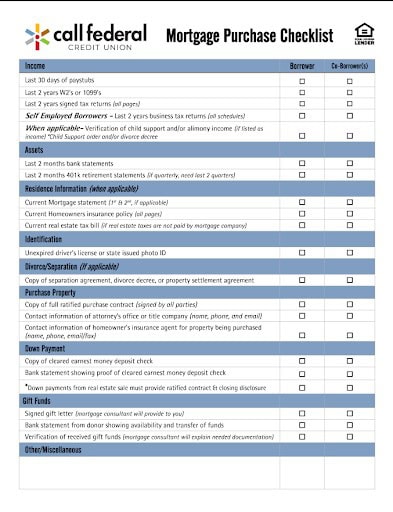
A home buying mission statement gives you a clearer picture of what you want in a home, where you want to look, and what budget range feels realistic. Call Federal’s mortgage checklist organizes the next part of the process: preparing for the mortgage conversation and keeping track of important documents.
Use the checklist alongside your mission statement. Your mission statement can guide your housing search, while the mortgage checklist keeps the financing details easier to manage as you move closer to applying for a home loan.
Use the checklist to keep track of items such as:
- Income documents, including recent paystubs, W-2s, 1099s, or tax returns
- Bank statements and other asset information
- Current mortgage, homeowners insurance, or real estate tax information, if applicable
- Driver’s license or state-issued photo ID
- Purchase contract and property-related contact information
- Earnest money deposit documentation
- Down payment records
- Gift fund documentation, if applicable
- Other items your mortgage consultant may request
The checklist is meant to be practical. You can print it, save it, or keep a copy on your phone so it is easy to reference as you move from the early housing search into the mortgage process.
Start Your Home Search With a Clearer Plan
Once you have worked through your must-haves, nice-to-haves, budget, and mortgage planning details, your home buying mission statement can act as a reminder of what matters most. It can also give your realtor and mortgage loan officer a clearer sense of what you are trying to accomplish before you start touring homes or making offers.
A housing search is easier to navigate when you know what you want, what you can afford, and which questions still need answers. Call Federal Credit Union works with homebuyers across the Richmond, VA area to compare mortgage programs, review estimated payments, and prepare for the next stage of the homebuying process.